Entities Required to Use Electronic Invoices Under the 2026 Regulations
Effective July 1, 2026, Decree No. 254/2026/ND-CP replaces Decree No. 123/2020/ND-CP and Decree No. 70/2025/ND-CP, providing detailed regulations on electronic invoices and documents under the Law on Tax Administration No. 108/2025/QH15. The Decree specifies the entities required to use electronic invoices, the corresponding invoice types, and applicable exemptions.
-
Entities Required to Use Electronic Invoices and Applicable Invoice Types
Clause 1, Article 6 of Decree No. 254/2026/ND-CP sets out the rules for using electronic invoices with tax authority codes, the eligibility requirements for electronic invoices without tax authority codes, the circumstances in which electronic invoices generated from cash registers must be used, and the requirements applicable to business households and individuals based on their annual revenue or the types of assets sold:
-
Economic organizations, other organizations, business households, individual business operators, and taxpayers classified as high-risk for tax purposes under regulations issued by the Minister of Finance. The specific assessment criteria are prescribed in Article 7 of Circular No. 91/2026/TT-BTC and other relevant tax risk management regulations.
-
Enterprises operating in electricity, petroleum, postal services, telecommunications, clean water supply, banking and finance, securities, crypto-assets, services supporting transactions on carbon exchanges, insurance, healthcare, e-commerce, supermarkets, general commerce, air transport, road transport, rail transport, maritime transport, and inland waterway transport; as well as economic organizations that have conducted or will conduct electronic transactions with tax authorities, established information technology infrastructure, and implemented accounting and electronic invoicing software capable of issuing, retrieving, and storing electronic invoices in accordance with regulations, while ensuring the transmission of electronic invoice data to buyers and tax authorities.
-
Economic organizations, business households, and individual business operators engaged in the sale of goods or provision of services, including direct sales or services to consumers in shopping centers, supermarkets, retail businesses (excluding automobiles, motorcycles, motorbikes, and other motor vehicles), food and beverage services, restaurants, hotels, passenger transportation, services directly supporting road transportation, performing arts, recreation, entertainment, cinema activities, and other personal services as classified under the Vietnam Standard Industrial Classification.
-
Business households and individual business operators with annual revenue exceeding VND 1 billion, or those selling assets subject to mandatory ownership or usage rights registration, must use electronic invoices with tax authority codes or electronic invoices generated from cash registers connected to tax authorities.
2. Types of Electronic Invoices and Applicable Conditions
Each type of electronic invoice is subject to specific requirements concerning invoice issuance procedures, data transmission timelines, and information reporting obligations to tax authorities. Businesses must therefore identify the appropriate invoice type from the outset to select a compliant invoicing system.
|
Entity Category
|
Invoice Type
|
Applicable Conditions
|
|
Economic organizations, other organizations, business households, and individual business operators
|
Electronic invoices with tax authority codes
|
Generally applicable unless the entity falls under provisions permitting another invoice type.
|
|
Enterprises operating in specified industries
|
Electronic invoices without tax authority codes
|
Must have adequate information technology infrastructure, accounting software, and the capability to transmit invoice data to buyers and tax authorities.
|
|
Businesses selling goods or providing services directly to consumers
|
Electronic invoices generated from cash registers
|
Registration for cash register-generated electronic invoices is not mandatory if the entity has already registered to use electronic invoices under Point a or Point b, Clause 1, Article 6.
|
|
Business households and individual business operators with annual revenue exceeding VND 1 billion
|
Electronic invoices with tax authority codes or invoices generated from cash registers connected to tax authorities
|
Annual revenue exceeds VND 1 billion, or the entity sells assets subject to mandatory ownership or usage rights registration.
|
2.1. Electronic Invoices with Tax Authority Codes
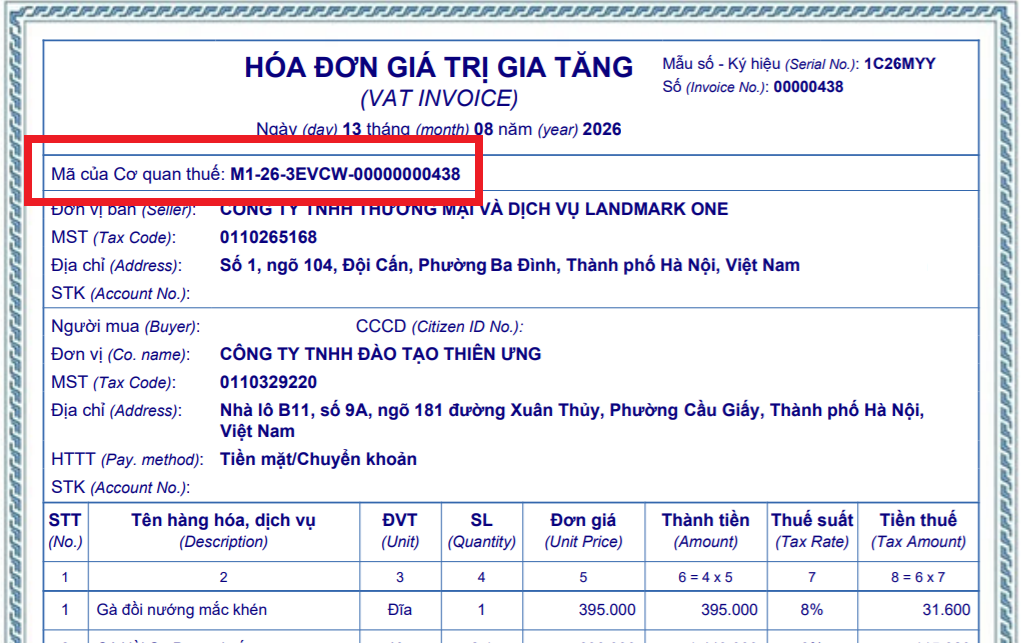
An electronic invoice with a tax authority code is an invoice assigned to a code by the tax authority before being sent by the seller to the buyer. Under Point a, Clause 1, Article 6 of Decree No. 254/2026/ND-CP, this invoice type applies to economic organizations, other organizations, business households, individual business operators, and taxpayers identified by the Ministry of Finance as presenting a high tax risk when selling goods or providing services.
For this invoice type, sellers must submit invoice data to the tax authority for code issuance before delivering the invoice to the buyer. It is generally applicable unless the entity qualifies to use electronic invoices without tax authority codes or invoices generated from cash registers under the relevant regulations.
2.2. Electronic Invoices Without Tax Authority Codes
Enterprises operating in electricity, petroleum, postal services, telecommunications, clean water supply, banking and finance, securities, crypto-assets, services supporting transactions on carbon exchanges, insurance, healthcare, e-commerce, supermarkets, general commerce, air transport, road transport, rail transport, maritime transport, and inland waterway transport may use electronic invoices without tax authority codes if they meet the conditions specified in Point b, Clause 1, Article 6 of Decree No. 254/2026/ND-CP, including:
-
Having conducted or intending to conduct electronic transactions with tax authorities.
-
Maintaining information technology infrastructure, accounting software, and invoicing software capable of issuing, retrieving, and storing electronic invoice data.
-
Ensuring the transmission of electronic invoice data to buyers and tax authorities.
Point b also specifies that businesses classified as high-risk taxpayers or those that have already registered to use electronic invoices with tax authority codes are not eligible to use electronic invoices without tax authority codes.
Operating in one of the listed sectors does not automatically qualify a business to use electronic invoices without tax authority codes. Businesses must meet all the requirements outlined above and must neither be classified as high-risk taxpayers nor have registered to use electronic invoices with tax authority codes.
2.3. Electronic Invoices Generated from Cash Registers
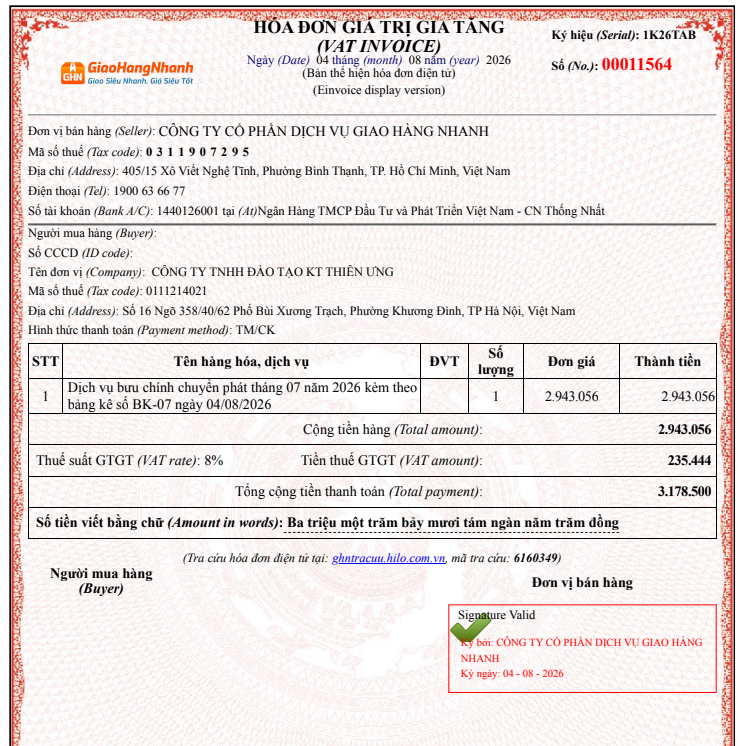
Economic organizations, business households, and individual business operators engaged in selling goods or providing services, including direct sales or services to consumers, are subject to the provisions governing electronic invoices generated from cash registers.
The sectors specified in Point c, Clause 1, Article 6 of Decree No. 254/2026/ND-CP include shopping centers, supermarkets, retail businesses (excluding automobiles, motorcycles, motorbikes, and other motor vehicles), food and beverage services, restaurants, hotels, passenger transportation, services directly supporting road transportation, performing arts, recreation, entertainment, cinema activities, and other personal services under the Vietnam Standard Industrial Classification.
However, economic organizations, business households, or individual business operators that have already registered to use electronic invoices with or without tax authority codes under Points a and b of the same clause are not required to register separately for electronic invoices generated from cash registers.
3. 8 Cases Where Electronic Invoices Are Not Required
In addition to the requirements for issuing electronic invoices, Article 7 of Decree No. 254/2026/ND-CP specifies eight cases in which electronic invoices are not required:
-
Business households and individual business operators selling goods or services in cases where the purchaser is permitted to prepare a purchase schedule under corporate income tax regulations, unless the seller registers to use e-invoices.
-
Business households and individual business operators earning income from real estate rentals; or from providing digital content products and services, including entertainment content, video games, digital films, digital images, digital music, and digital advertising, to foreign organizations or individuals.
-
Business households and individuals acting as lottery agents, insurance agents, or multi-level marketing agents where the relevant enterprises have already withheld tax.
-
Fees and other income arising from reinsurance activities; deposit-taking; financial activities, including the issuance of certificates of deposit, primary issuance of securities, and issuance of valuable papers; debt sales; foreign exchange transactions; and derivative products. For foreign currency sales transactions, at the end of each month, the entity must prepare a detailed summary of all transactions conducted, based on data recorded in its management system. The entity is responsible for ensuring the accuracy of the information and must provide the summary to the tax authority or other competent state authorities upon request.
-
Capital contributions are made in the form of assets by business organizations or individuals to economic organizations.
-
Asset transfers between a parent company and its dependent accounting units, or asset transfers arising from the division, separation, consolidation, merger, or conversion of an enterprise's legal form.
-
Machinery and equipment lent without charge or transfer of ownership, including fixed assets, tools, and equipment used for processing goods on behalf of the lending party.
-
Goods transferred internally for further production, goods used internally for business operations, and receipts unrelated to sales, such as compensation, bonuses, and collections on behalf of other parties (under Points a and b, Clause 1, Article 6 and Point b, Clause 1, Article 14 of Decree No. 181/2025/ND-CP).
Note: The exemptions from electronic invoicing requirements under Article 7 of Decree No. 254/2026/ND-CP apply only when the prescribed conditions and scope are fully satisfied. An exemption from electronic invoicing does not necessarily exempt an entity from other obligations relating to supporting documentation, tax declarations, and record retention.
4. Key Considerations When Using Electronic Invoices
Electronic invoicing requires businesses to comply with applicable regulations throughout the issuance, delivery, and management of invoices. To minimize errors and fulfill their regulatory obligations, businesses should consider the following:
-
Identify the applicable entity category: Assess the business structure, operating sector, and conditions specified in Article 6 of Decree No. 254/2026/ND-CP to determine the appropriate electronic invoice type.
-
Review applicable exemptions: Refer to Article 7 of Decree No. 254/2026/ND-CP to determine whether a transaction qualifies for an exemption from electronic invoicing requirements, while considering any related documentation obligations.
-
Meet electronic invoicing requirements: verify compliance with registration, technology infrastructure, invoicing software, and data transmission requirements applicable to the selected invoice type.
5. GenInvoice – Automated Electronic Invoicing
Once the appropriate electronic invoice type and format have been determined, businesses must establish suitable procedures for preparing, issuing, and monitoring invoices. For e-commerce sellers, integrating order data into these processes can reduce manual data entry and facilitate reconciliation.
GenInvoice, the electronic invoicing feature of Genbook, enables Amazon and Etsy sellers to synchronize order data, generate draft invoices, issue invoices in batches, and track invoice statuses.
Contact Genbook to discuss implementing GenInvoice in line with your business model and electronic invoicing requirements.
Suggested Topics:
#E-commerce#bookkeeping#accounting#finance
G
Tracy


